

Latest Mobile SIM Rules and Technology AI Offers

India’s SIM Card Rules & Limits :
In an era where digital connectivity powers everything from financial transactions to social communication, mobile numbers have become the primary identity anchor for citizens across India. However, with the rapid rise in telecommunication networks, cyber fraud, spam calls, and identity theft have also scaled exponentially. To tackle these growing security concerns and streamline subscription verification, the Department of Telecommunications (DoT), under the Ministry of Communications, has re-emphasized strict compliance regarding the maximum number of active mobile SIM connections an individual can legally hold.
Understanding the National SIM Card Limit
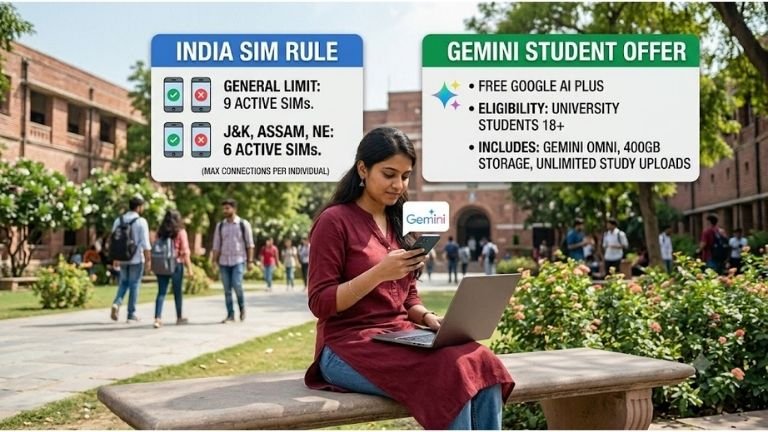
According to the official guidelines laid down by the Department of Telecommunications, a individual subscriber in most parts of India is permitted to hold a maximum of 9 active mobile connections across all telecom service providers (such as Reliance Jio, Bharti Airtel, Vodafone Idea, and BSNL).
This limit applies cumulatively. For instance, if you hold three Jio connections, three Airtel numbers, and three Vi connections registered under your primary identity proof (like your Aadhaar card or Voter ID), you have reached your legal limit of nine. Telecom operators are integrated with centralized database systems to verify these numbers, meaning any attempt to purchase a 10th mobile connection will be automatically flagged and rejected during the subscriber verification process.
Stricter Restrictions in Sensitive Regions
While the general national threshold stands at nine connections, the federal government has implemented heightened security protocols for certain strategic and sensitive regions. For individual subscribers residing in or holding identity proofs from Jammu & Kashmir, Assam, and the North-Eastern licensed service areas, the maximum permitted limit is capped at 6 active mobile connections.
These stricter regional limits have been enforced due to geopolitical sensitivities, cross-border security considerations, and a higher vulnerability to fraudulent SIM card circulation used in illicit activities. Subscribers in these designated zones will be barred from obtaining a 7th mobile connection under their credentials.
Why Is the Government Enforcing This Limit?
The primary objective behind enforcing strict caps on mobile connections is combatting the growing menace of financial cyber fraud and impersonation scams. Cybercriminals frequently use “mule SIMs”—connections obtained using stolen or forged identity documents—to execute phishing schemes, digital arrests, and fake bank transfer frauds.
By limiting the number of SIM cards tied to a single individual, security agencies and telecom regulators can easily trace suspicious activity back to legitimate owners, reducing the circulation of untraced, illegally acquired SIM cards.
How to Check How Many SIMs Are Registered Under Your Name
Many citizens remain unaware that fraudsters might have illegally acquired mobile connections using their Aadhaar details or identity documents. To protect users, the Department of Telecommunications launched the TAFCOP (Telecom Analytics for Fraud Management and Consumer Protection) portal under the unified Sanchar Saathi initiative.
Here is how you can check and report unauthorized connections:
-
Visit the Portal: Go to the official Sanchar Saathi website (
sancharsaathi.gov.in). -
Enter Mobile Number: Navigate to the ‘Know Your Mobile Connections’ section and enter your primary active mobile number.
-
OTP Verification: Enter the OTP sent to your phone along with the captcha code.
-
Review Registered Numbers: The portal will display a comprehensive list of all mobile numbers registered under your identity document.
-
Take Action: If you spot a number that does not belong to you or one that you no longer use, you can select the number and click on “Not My Number” or “Not Required” to initiate a disconnection request immediately.
Google Launches Free AI Plus Offer for College Students in India :
Artificial intelligence is rapidly transforming how students research, write code, analyze data, and prepare for academic examinations. Recognizing the growing demand for advanced AI technology among young scholars, tech giant Google has introduced an exclusive Google AI Plus Student Offer specifically tailored for university students in India.
Under this promotional offer, eligible college and university students can unlock premium Google AI features, enhanced storage capabilities, and productivity tools completely free of cost, providing a massive boost to their academic workflow.
Key Benefits Included in the Google AI Plus Student Offer
The student package is designed to offer far more than basic AI chat capabilities. By subscribing to the offer, eligible students gain access to a suite of advanced features:
-
Access to Gemini Omni: Students get direct access to Google’s highly versatile flagship multimodal model, Gemini Omni, allowing them to seamlessly process text, code, audio, images, and video inputs in real-time.
-
Higher Usage & Processing Limits: Unlike standard free tier users who face strict daily query caps during peak hours, AI Plus subscribers receive significantly elevated usage limits to handle extensive research sessions.
-
400GB Cloud Storage: The offer bundles a massive 400GB of upgraded Google Cloud storage spanning Google Drive, Gmail, and Google Photos, ensuring students never run out of room for massive datasets, research papers, and media projects.
-
Unlimited Uploads for Study Notebooks & Visuals: Students can upload unlimited study materials, reference PDFs, complex visual charts, and recorded live sessions into specialized Study Notebooks for automated summarization, flashcard generation, and concept explanation.
Eligibility Criteria
To take advantage of this complimentary tier, applicants must meet specific requirements specified on the official Google landing page:
-
Geographic Location: The applicant must be residing and studying in India.
-
Age Requirement: Students must be 18 years of age or older at the time of application.
-
Academic Enrollment: Applicants must be currently enrolled in an accredited higher education institution, university, or degree-granting college.
How Students Can Claim the Free Subscription
Claiming the offer requires standard verification to confirm active student status:
-
Navigate to the Official Landing Page: Visit the designated Google Student Offer portal.
-
Sign In: Log in using your primary personal Google Account.
-
Complete Student Verification: Google utilizes SheerID, a third-party verification platform, to confirm enrollment. Students will need to input their full name, educational institution, and official university-issued email address (
.eduor institutional domain). -
Document Submission (If Prompted): If auto-verification fails via institutional email, students can upload supporting documents such as a current student ID card, tuition fee receipt, or official enrollment certificate displaying their name and current academic year.
-
Annual Re-Verification: The offer remains valid subject to eligibility, and students will be required to complete an annual verification process to retain their complimentary AI Plus privileges throughout their degree program.
Also read : https://daytodaynews.net/7-healthy-chips-you-can-eat-guilt-free/
1 thought on “Latest Mobile SIM Rules and Technology AI Offers on 28th Aug”