

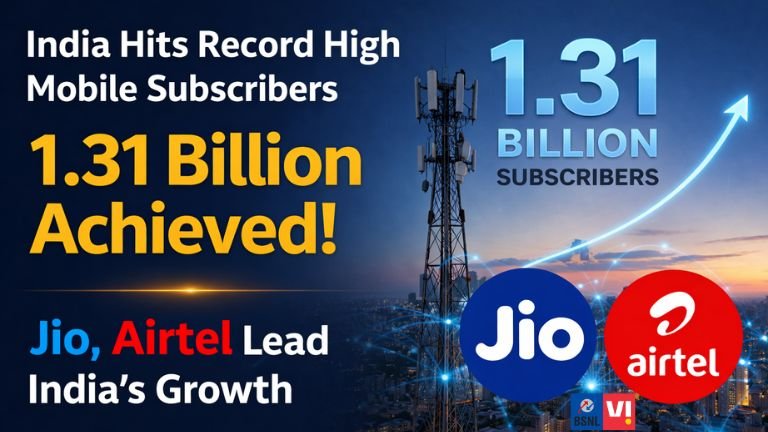
India’s telecommunications landscape has long been a global benchmark for rapid growth and digital inclusion. As of January 2026, the sector has reached a monumental milestone: the total number of Telecom users in India has crossed 1.31 billion: Reliance Jio and Airtel are ruling the market. This growth is not just a number; it represents the heartbeat of “Digital India,” where connectivity has transitioned from a luxury to a fundamental right.
According to the latest data released by the Telecom Regulatory Authority of India (TRAI), the month of January alone saw an addition of approximately 7.8 million new users. This surge highlights a resilient market that continues to expand even as it nears saturation in urban hubs.
The Battle for Supremacy: Airtel vs. Jio
For years, Reliance Jio has been the undisputed king of subscriber additions, fueled by aggressive pricing and massive 5G rollouts. However, the January 2026 report suggests a fascinating shift in consumer sentiment.
1. Bharti Airtel’s Record-Breaking Month In a surprising turn of events, Bharti Airtel emerged as the leader in monthly subscriber gains. The telco added a staggering 4.42 million new users in January. Analysts suggest that Airtel’s focus on high-quality network infrastructure and its “premiumization” strategy—targeting high-value users—is paying off. By offering superior 5G consistency and attractive bundled services (like OTT subscriptions and high-speed data), Airtel is successfully poaching users from competitors and attracting new digital natives.
2. Reliance Jio Stays Strong but Settles for Second Reliance Jio, while still the largest operator in terms of total market share, added 2.41 million subscribers in the same period. While these numbers are healthy, they represent a slight cooling off compared to previous peaks. Jio’s current strategy seems to be shifting toward “monetization” and “home connectivity.” Through its JioAirFiber and JioFiber services, the company is aiming to dominate the home broadband market, even as mobile subscriber growth stabilizes.
The Deepening Crisis for Vodafone Idea (Vi) and BSNL
While the top two players are locked in a high-stakes race, the story for the other two major entities is starkly different.
-
Vodafone Idea (Vi): The struggles for Vi continue unabated. In January 2026, the company lost approximately 4.11 lakh (411,000) subscribers. Despite efforts to raise capital and modernize its 4G network, the lack of a pan-India 5G presence is causing a steady exodus of users. Consumers are increasingly prioritizing 5G connectivity, and Vi’s delay in this department is proving costly.
-
BSNL: The state-run Bharat Sanchar Nigam Limited (BSNL) also faced a decline. Despite government intervention and a focus on indigenous 4G technology, the slow pace of implementation has led users toward private players who offer more robust data speeds and customer service.

The Broadband Explosion
A significant portion of India’s telecom growth is now driven by data. The total number of broadband subscribers (including both wireless and wired) has crossed the 1.05 billion mark.
The dominance in this sector is clear:
-
Reliance Jio holds a commanding 49% of the broadband market share.
-
Bharti Airtel follows with a solid 28% share.
This explosion in broadband usage is fueled by the rise of short-form video content, remote work, and the massive popularity of digital payment systems even in the remotest corners of the country.
Urban Saturation vs. Rural Opportunity
The TRAI report highlights a widening gap and a unique opportunity.
-
Urban Subscribers: 768 million users.
-
Rural Subscribers: 545 million users.
While urban India has a teledensity of over 130% (meaning many people have more than one SIM card), rural India sits at roughly 60%. This 40% gap is the “next frontier” for companies like Jio and Airtel. Massive investments are currently being funneled into rural infrastructure to bring high-speed 5G to villages, which is expected to revolutionize agriculture, healthcare, and education.
Mobile Number Portability (MNP): The Power of Choice
Indian consumers have never been more empowered. In January 2026, roughly 16.2 million MNP requests were filed. This means millions of users decided to switch their service provider while keeping their existing number. The high volume of MNP requests indicates that brand loyalty is secondary to service quality. If a network drops calls or offers slow data, the Indian consumer is quick to jump ship.
The 5G Impact and the Path to 6G
India’s 5G rollout has been one of the fastest in the world. As of 2026, 5G is no longer a futuristic concept; it is the standard for most urban dwellers. The high speeds offered by 5G have led to an increase in ARPU (Average Revenue Per User) for telcos, as users consume more data for high-definition streaming and gaming.
Furthermore, the Indian government has already begun laying the groundwork for 6G technology. By fostering local R&D and patent filings, India aims to be a leader in the next generation of connectivity, ensuring that the country remains at the forefront of the global digital economy.
Conclusion: A Duopoly in the Making?
The January 2026 data confirms that India is moving toward a “two-horse race” between Jio and Airtel. While this ensures high-quality service and rapid innovation, it also raises concerns about competition. For a healthy ecosystem, a strong third player is essential. Whether Vodafone Idea can stage a comeback or BSNL can successfully deploy its 4G/5G network will determine the long-term pricing and choices available to the Indian consumer.
For now, the winner is clearly the Indian user, who enjoys some of the lowest data prices and fastest growth rates in the world. please visit TRAI website https://www.trai.gov.in/release-publication/reports/telecom-subscriptions-reports for more information.
1 thought on “Telecom users in India has crossed 1.31 billion: Reliance Jio and Airtel are ruling the market.”