

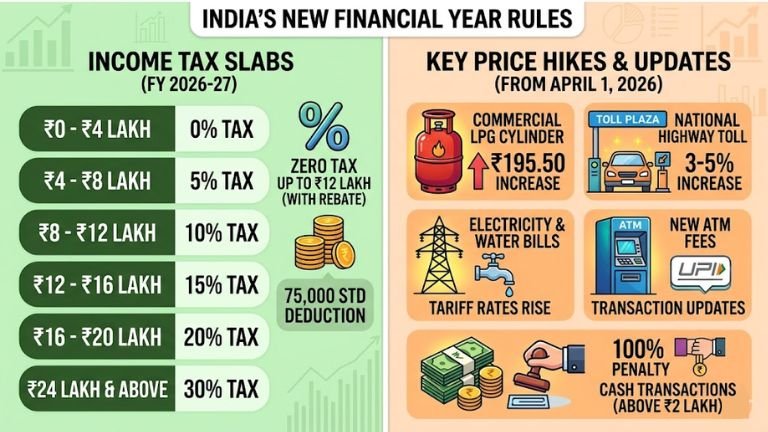
New Financial Year 2026-27: Every Major Changes, April 1st is not just another date on the calendar in India; it marks the beginning of a new Financial Year (FY 2026-27). While it usually brings hope for new investments and economic growth, this year, it has arrived with a “price hike” sting. From your kitchen to your commute, and from digital payments to your bank account, several new rules have been implemented today.
Unfortunately, these changes are set to tighten the monthly budgets of middle-class families. As the Central and State governments roll out new policies, understanding these 10 major shifts is crucial for every citizen to plan their finances effectively.

1. Commercial LPG Cylinder Price Hike: Dining Out Becomes Dearer
Oil marketing companies (OMCs) have dealt a heavy blow to the hospitality sector on the very first day of the financial year. The price of commercial LPG cylinders (19kg) has been hiked by approximately ₹195.50.
While domestic cylinder prices remain stable for now, this massive hike in commercial gas will directly impact small hotels, cafes, and large restaurants. Business owners often pass these costs down to consumers, meaning your daily cup of tea, coffee, and outside meals are likely to get more expensive starting today.
2. National Highway Toll Rates Increased: Travel Gets Costly
If you are planning a long drive or a road trip after April 1, be prepared to shell out more at toll plazas. The National Highways Authority of India (NHAI) has increased toll rates across the country by 3% to 5%.
This hike doesn’t just affect private car owners; it has a cascading effect on the economy. Increased toll rates for trucks and lorries mean higher transportation costs for essential goods, which could eventually lead to a rise in the prices of vegetables and other market commodities.
3. Electricity and Water Tariff Revisions
Several states and Electricity Supply Companies (ESCOMs) have released their new tariff charts today. Citing rising coal procurement and maintenance costs, electricity rates have been increased by 20 to 50 paise per unit.
Additionally, major metropolitan cities have implemented a 3% hike in water charges. Coming at the peak of the summer season when consumption is at its highest, these utility hikes are a double whammy for households already struggling with inflation.
4. Banking Sector: New ATM and Minimum Balance Rules
Major private and public sector banks have updated their service charge structures:
-
ATM Withdrawal Fees: The limit for free monthly ATM transactions has been tightened. Withdrawing cash more than five times from your own bank’s ATM will now attract a fee of ₹23 + taxes per transaction.
-
Minimum Balance (MAB): Some banks have raised the Minimum Average Balance requirement for savings accounts. Failure to maintain this limit will now result in higher penalty charges, increased by nearly 10% compared to last year.
-
SMS & Cheque book Charges: Free cheque book leaves have been reduced, and quarterly SMS alert fees have seen a marginal increase.
5. UPI Transaction Updates and Security
As part of the Digital India initiative, UPI (Unified Payments Interface) has introduced new security layers. While peer-to-peer (P2P) transfers remain free, certain “Merchant Transactions” in specific high-value categories will now attract small interchange fees. Furthermore, using Credit Cards on UPI platforms like PhonePe or Google Pay for utility bills might now include a small “convenience fee” depending on the platform’s updated policy.
6. The 100% Cash Transaction Penalty: A Strict Warning
In a massive move to curb black money and tax evasion, the government has enforced a strict penalty on large cash transactions. Under the new guidelines, if an individual accepts or pays more than ₹2 Lakh in cash in a single day, a 100% penalty will be levied.
For example, if you conduct a cash transaction of ₹3 Lakh, the government can impose a fine of the entire ₹3 Lakh. This makes digital payments, NEFT, or Cheque transactions the only safe way to handle large sums.
7. Green Tax and Scrappage Policy Incentives
Owners of old vehicles will face higher “Green Tax” starting today. The cost of renewing registration for vehicles older than 15 years has been made significantly more expensive. This is part of the government’s push for the National Vehicle Scrappage Policy, aiming to remove polluting vehicles from the road and encourage the purchase of new, eco-friendly models.
8. Historical Shift: Income Tax Act 2025 Comes into Force
For the first time in over six decades, the old Income Tax Act of 1961 is being replaced by the New Income Tax Act of 2025. This brings a simplified tax structure and new slabs for FY 2026-27.
New Tax Regime Slabs (FY 2026-27): The New Tax Regime is now the ‘Default’ choice. Under Section 87A, individuals with an annual income of up to ₹12 Lakh will pay Zero Tax (after rebates). The Standard Deduction for salaried employees remains at ₹75,000.
-
₹0 – ₹4 Lakh: Nil
-
₹4 – ₹8 Lakh: 5%
-
₹8 – ₹12 Lakh: 10%
-
₹12 – ₹16 Lakh: 15%
-
₹16 – ₹20 Lakh: 20%
-
₹24 Lakh & Above: 30%
9. PAN Card: New Documentation Rules
The process of obtaining or updating a PAN card has become more rigorous.
-
Additional Documents: From today, you can no longer get a PAN card solely based on an Aadhaar card. You must provide a secondary document like a Voter ID, Passport, or Birth Certificate.
-
Name Matching: Strict “Name Matching” protocols are in place. Even a minor mismatch between your Aadhaar and PAN details could lead to the deactivation of your PAN card.
-
Form 93: All new applications must now be submitted using the updated ‘Form 93’, replacing the old Form 49A.
10. Real Estate and Insurance Mandates
-
Property Purchases: The threshold for mandatory PAN disclosure during property transactions has been increased from ₹10 Lakh to ₹20 Lakh, offering some relief to small-scale buyers.
-
Insurance KYC: Regardless of the premium amount, providing your PAN card details is now mandatory for purchasing any new insurance policy (Life, Health, or Motor).
Conclusion: Navigating the New Financial Era
New Financial Year 2026-27: Every Major Changes aims to bring transparency and digital discipline to the Indian economy, the immediate effect is a surge in daily living costs. From gas and tolls to electricity and banking fees, the “April 1st effect” is real. While the tax relief for those earning under ₹12 Lakh is a welcome move, the rising cost of commodities might offset those savings. It is now imperative for every household to revisit their monthly budgets and adapt to these new financial realities.
Also read : Historic Kumbh Mela in J&K & Ladakh 2026: Dates, Sacred Locations & What Devotees Should Know
3 thoughts on “New Financial Year 2026-27: Every Major Changes in LPG, Toll, and Income Tax”