

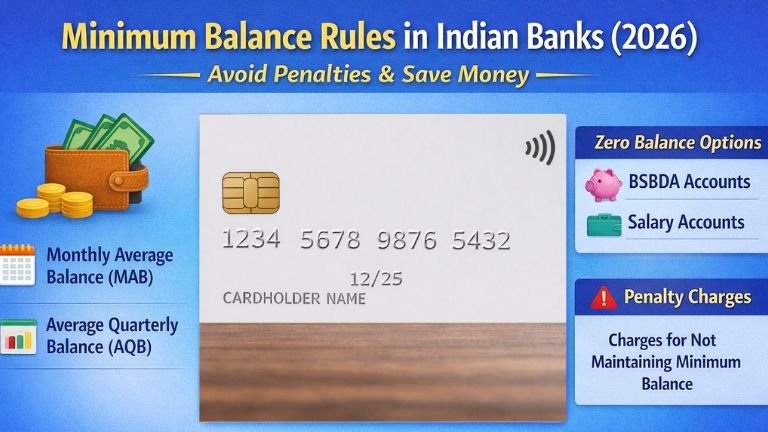
The concept of a “minimum bank balance” in India has undergone a significant transformation over the last few years. Following various Reserve Bank of India (RBI) mandates and shifting market dynamics between public sector units (PSUs) and private giants, the rules are more nuanced than a single fixed number. Whether you are a student, a salaried professional, or a rural entrepreneur, understanding these requirements is essential to avoid unnecessary penalties.
In the Indian banking ecosystem, the minimum requirement is typically calculated as a Monthly Average Balance (MAB) or Average Quarterly Balance (AQB). This means the bank does not necessarily require you to have the specific amount in your account every single day. Instead, it calculates the average of your daily closing balances over the month or quarter. If the average meets the threshold, no penalty is levied.
1.Public Sector Banks: The “People’s Choice” for Low Entry
Public sector banks (PSBs) are generally the most accessible for those looking for low minimum balance requirements.
- State Bank of India (SBI): In a landmark move a few years ago, SBI—India’s largest lender—waived the minimum balance requirement for all its savings bank accounts. This applies across metro, urban, semi-urban, and rural branches. For millions of Indians, this turned the standard savings account into a “Zero Balance” account by default.
- Punjab National Bank (PNB) & Bank of Baroda (BoB): These banks still maintain tiered structures. In metro and urban areas, the requirement typically fluctuates between ₹5,000 and ₹10,000. In semi-urban areas, it drops to ₹2,000, and in rural areas, it can be as low as ₹1,000.
- Other PSBs: Banks like Union Bank of India and Canara Bank often have even lower thresholds, sometimes starting at ₹500 to ₹1,000 for rural customers, making them highly favourable for low-income households.
2. Private Sector Banks: Premium Services at a Cost
Private banks focus on technology-driven, high-speed services, but this often comes with a steeper minimum balance requirement.
- HDFC Bank & ICICI Bank: These leaders typically require a MAB of ₹10,000 for metro and urban branches. However, in 2025 and early 2026, many private banks introduced “Premium” variants where the requirement can jump to ₹25,000 or even ₹50,000 for accounts that include perks like free doorstep banking or unlimited ATM withdrawals. In rural areas, HDFC and ICICI usually lower the bar to ₹2,500.
- Axis Bank & Kotak Mahindra Bank: These follow a similar pattern, with metro requirements sitting at ₹10,000 to ₹12,000. Kotak is unique for its “811” digital account, which was popularized as a zero-balance digital-only offering, though their physical branch accounts maintain standard high thresholds.
3. The RBI’s “Safety Net”: BSBDA Accounts
If you are worried about maintaining a balance, the RBI has mandated that every bank must offer a Basic Savings Bank Deposit Account (BSBDA).
What is a BSBDA?
It is a “Zero Balance” account available to any Indian citizen. There is no requirement for an initial deposit or a minimum monthly balance. However, these accounts come with strict limitations:
- Maximum of 4 withdrawals per month (including ATM).
- Total credits in a year cannot exceed ₹1 lakh.
- Total balance at any point cannot exceed ₹50,000.
4. Special Categories: Salary, Students, and Seniors
Not all accounts are created equal. Many people unknowingly pay penalties on accounts that could otherwise be exempt.
- Salary Accounts: These are almost always “Zero Balance.” As long as your employer credits your salary monthly, the bank waives the MAB. However, a common pitfall occurs when an employee leaves a job. If no salary is credited for 3 to 6 consecutive months, the bank automatically converts the account into a regular savings account, and MAB penalties begin to apply.
- Student Accounts: Designed for those under 25, these accounts often have a “NIL” or very low (₹500) requirement to encourage banking habits early on.
- Senior Citizen Accounts: Banks often offer reduced MAB requirements for those over 60, alongside slightly higher interest rates on Fixed Deposits.
5. Geography Matters: The Tiered System
India’s banking regulations recognize the economic disparity between a resident of Mumbai and a farmer in a remote village. Requirements are tiered based on the branch location:
- Metro: Highest requirements (due to high operational costs).
- Urban: Slightly lower than Metro.
- Semi-Urban: Moderate requirements (often 50% of the Metro rate).
- Rural: Lowest requirements, often focused on financial inclusion.
6. Consequences of Non-Maintenance
When the average balance falls below the threshold, banks do not just take a flat fee; they apply a tiered penalty system.
- The “Shortfall” Rule: The penalty is usually proportional to the gap between your actual balance and the required balance.
- Charges: These typically range from ₹50 to ₹600 per month, plus 18% GST.
- RBI Protection: The RBI mandates that banks cannot let an account balance go into “negative” purely due to non-maintenance charges. They can reduce the balance to zero, but they cannot create a debt for the customer based solely on these fees.
7. Digital and Payments Banks: The New Frontier
With the rise of Fintech, Payments Banks like Airtel Payments Bank and India Post Payments Bank (IPPB) have gained traction. These are almost exclusively zero-balance or very low-balance (₹100–₹500) accounts. They are excellent for daily UPI transactions but have a maximum deposit limit (currently ₹2 lakh) and do not offer credit cards or loans.
Summary Table
| Category | Typical Minimum Balance (Metro) | Best For |
| Public Banks (SBI) | ₹0 | Everyone / No-frills banking |
| Public Banks (Others) | ₹1,000 – ₹5,000 | Low-cost traditional banking |
| Private Banks | ₹10,000 – ₹25,000 | High-tech features / Convenience |
| BSBDA (Jan Dhan) | ₹0 | Basic needs / Financial inclusion |
| Salary Accounts | ₹0 | Employees with active monthly credits |
Conclusion :
Minimum Balance Rules in Major Indian Banks where Choosing the right bank depends on your liquidity. If you cannot guarantee a ₹10,000 cushion, a public sector bank like SBI or a BSBDA account is the safest bet to avoid eroding your savings through fees. Always check your bank’s specific Schedule of Charges annually, as these rates are frequently updated in April at the start of the new financial year.
Would you like me to generate a detailed guide on how to convert a regular account into a zero-balance BSBDA account?
Also Read : RCB franchise sold for $1.78 billion! Aditya Birla & TOI Group Take Over in Record-Breaking Deal