

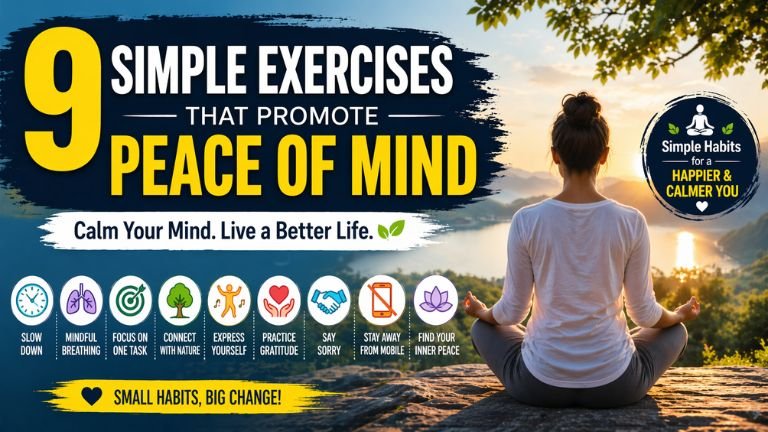
In the modern era, our lives are defined by a constant rush. We are perpetually connected, frequently overwhelmed, and often find ourselves running on a treadmill of endless tasks. While technological and professional advancements have brought us comfort, they have often come at the cost of our most precious asset: peace of mind. Mental tranquillity isn’t just a luxury; it is the foundation of physical health, productive work, and meaningful relationships. If you find yourself feeling anxious, scattered, or emotionally exhausted, it is time to recalibrate. Here are nine transformative exercises and lifestyle shifts designed to help you rediscover inner calm – 9 Powerful Exercises to Reclaim Your Peace of Mind.

1. Embrace the Concept of “Slow Light”
Our circadian rhythms—the internal clock that tells us when to wake and sleep—are deeply influenced by light. In a world dominated by blue light from smartphones and harsh overhead LEDs, our nervous systems are often kept in a state of high alert long after the sun has set.
The Exercise: As evening approaches, transition your environment to “Slow Light.” Switch off bright overhead fixtures and use warm-toned lamps or even candles. Minimize screen usage at least an hour before bed. The Impact: This practice signals your brain to produce melatonin, the sleep hormone. By lowering the light intensity, you lower your cortisol (stress hormone) levels, allowing your mind to drift from the “active” mode into a “restorative” state.
2. Master the Art of Mindful Breathing
Breathing is the only autonomic function of the body that we can consciously control. It is a direct bridge to the nervous system. When we are stressed, our breath becomes shallow and rapid, triggering the “fight or flight” response.
The Exercise: Practice the 4-7-8 technique. Inhale quietly through your nose for a count of 4, hold your breath for a count of 7, and exhale forcefully through your mouth for a count of 8. The Impact: This act of mindful breathing physically forces your body into a “rest and digest” state. It oxygenates the blood and centers your wandering thoughts, providing an anchor of calm in the midst of a chaotic day.
3. Reject Multitasking: Do One Work at a Time
Society often praises the “multitasker,” but neuroscience tells a different story. The brain doesn’t actually do multiple things at once; it rapidly switches between them, which increases cognitive load and causes mental fatigue.
The Exercise: Practice “Single-Tasking.” If you are writing an email, close all other tabs. If you are eating, just eat—without watching TV or scrolling through your phone. Give your full, undivided attention to the task at hand. The Impact: When you focus on one thing, you enter a “flow state.” This reduces the feeling of being scattered and provides a sense of accomplishment and clarity that multitasking never can.
4. Immerse Yourself in Nature
We are biological beings, yet we spend 90% of our lives indoors. “Nature Deficit Disorder” is a real phenomenon that contributes to heightened anxiety.
The Exercise: Make it a non-negotiable habit to spend time outdoors daily. Whether it’s a 15-minute walk in a local park, sitting under a tree, or even tending to balcony plants, get close to the earth. The Impact: Nature has a fractal quality that the human eye finds inherently soothing. The sounds of birds, the rustle of leaves, and the feeling of fresh air lower heart rates and significantly reduce “rumination”—the tendency to dwell on negative thoughts.
5. Release the Burden of Expectations
A significant portion of our mental unrest comes from the gap between our expectations and reality. We expect people to behave in certain ways, or we expect our lives to follow a specific timeline. When reality deviates from these scripts, we suffer.
The Exercise: Practice “Expectation Auditing.” Identify a situation causing you stress and ask, “What am I expecting here that isn’t happening?” Consciously choose to lower that expectation or let it go entirely. The Impact: By accepting reality as it is—not as you wish it to be—ನೀವು (you) reclaim your power. Peace comes from the internal decision to remain unshaken regardless of external outcomes.
6. Reconnect with Creative Expression (Singing, Dancing, Drawing)
As we grow older, we often abandon the “play” that defined our childhood. We stop drawing because we aren’t “artists” or stop singing because we don’t have “good voices.” However, creativity is a powerful release valve for suppressed emotions.
The Exercise: Dedicate time each week to creative play. Sing loudly in the car, dance in your living room, or doodle in a notebook. The goal isn’t perfection; it’s expression. The Impact: These activities release endorphins and dopamine. They allow the logical, worrying side of the brain to rest while the intuitive, creative side takes over, providing a profound sense of liberation.
7. Cultivate a “Heart of Gratitude”
The human brain is evolutionarily wired with a “negativity bias”—we notice threats and problems much more easily than blessings. This bias can lead to a chronic state of dissatisfaction.
The Exercise: Start or end your day by listing three specific things you are thankful for. Don’t just list them; feel the warmth of that gratitude in your chest. The Impact: Over time, this exercise rewires your neural pathways to seek out the positive. It shifts your internal narrative from “what is lacking” to “what is abundant,” which is the ultimate recipe for peace.
8. The Power of “Sorry” and Letting Go
Guilt and resentment are heavy weights to carry. Holding a grudge is like drinking poison and waiting for the other person to die. Similarly, unaddressed mistakes on our part create a nagging sense of unease.
The Exercise: If you have wronged someone, offer a sincere apology without making excuses. If someone has wronged you, practice forgiveness—not for their sake, but for yours. The Impact: Saying “I’m sorry” or “I forgive you” clears the emotional air. It resolves the “open loops” in your mind, allowing you to live in the present rather than being haunted by the past.
9. Digital Detox: Step Away from the Mobile
The smartphone is a portal to the entire world’s problems, opinions, and comparisons. Constant notifications keep our brains in a state of hyper-vigilance, making true peace impossible.
The Exercise: Create “Phone-Free Zones.” No phones at the dinner table, no phones in the bedroom, and no phones for the first hour of the day. Periodically, take a full 24-hour break from social media. The Impact: This breaks the dopamine-loop of seeking validation through likes and comments. It allows you to rediscover your own voice and thoughts, leading to a much deeper and more sustainable form of mental quiet.
Final Thoughts
9 Powerful Exercises to Reclaim Your Peace of Mind – Peace of mind is not something you find outside—it’s something you create within yourself. It doesn’t happen overnight, but with small daily habits, you can slowly build a calm and balanced life.
Start with just one or two of these exercises and gradually include more into your routine. Be patient with yourself and stay consistent.
Remember, your mental health is just as important as your physical health. When your mind is peaceful, everything in life feels better—your relationships, your work, and your overall happiness.
Take a deep breath, slow down, and give yourself the peace you truly deserve. 🌿✨
Also Read : 5 Best Cold Drinks for Summer 2026: Stay Cool & Beat the Heat Naturally