

EV Industry Growth 2026: The Indian automotive sector witnessed a ground breaking moment in March 2026, as electric vehicle (EV) sales, encompassing both electric bikes (two-wheelers) and electric cars (four-wheelers), skyrocketed to unprecedented levels. This surge wasn’t merely incremental growth; it was a watershed moment driven by a confluence of powerful factors, positioning India as a global leader in EV adoption and signalling a significant shift away from traditional internal combustion engines (ICE). The record-breaking performance in March marked a triumphant end to the 2025-26 fiscal year and set a robust foundation for a greener future.
Electric Two-Wheelers: Leading the Charge
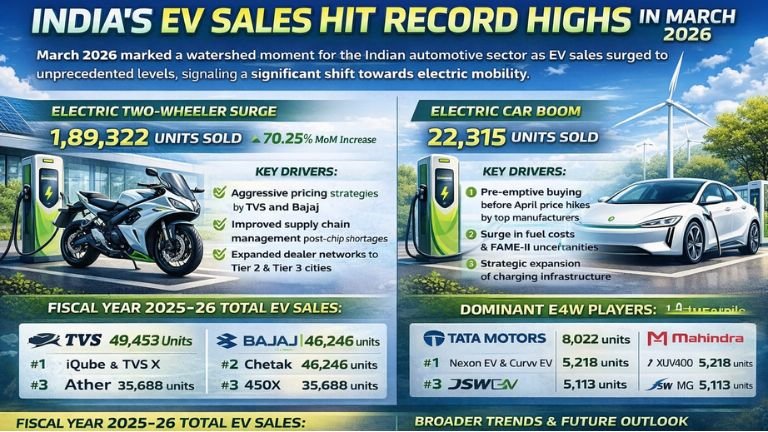
EV Industry Growth 2026: The electric two-wheeler segment, comprising electric bikes and scooters, experienced an almost unimaginable boom in March 2026. A phenomenal 1,89,322 units were registered, representing a staggering 70.25% month-on-month (MoM) increase from the 1,11,203 units sold in February. This wasn’t just a monthly record; it was a clear indication that the Indian consumer’s mindset has decisively shifted towards electric mobility for daily commuting.
Several factors coalesced to fuel this extraordinary growth:
- Aggressive Pricing Strategies: Major players like TVS and Bajaj implemented strategic price adjustments, making their electric offerings fiercely competitive with high-end ICE scooters. This narrowed the price gap and removed a significant hurdle for potential buyers.
- Improved Supply Chain Management: After facing intermittent chip shortages in previous years, manufacturers stabilized their supply chains by March 2026. This allowed them to ramp up production and meet the burgeoning demand without facing major inventory backlogs.
- Strategic Marketing and Distribution Expansion: Companies like TVS, Bajaj, and Ather aggressively expanded their dealer networks, particularly in Tier 2 and Tier 3 cities, making their products accessible to a wider demographic. Targeted marketing campaigns emphasizing low running costs and environmental benefits resonated strongly with cost-conscious Indian consumers.
Top Performers in the E2W Segment:
The battle for dominance in the electric two-wheeler market was fiercely contested:
- TVS Motor Company: TVS secured the top position with 49,453 units This success can be largely attributed to the sustained popularity of the iQube electric scooter and the timely rollout of the performance-oriented TVS X. TVS’s robust after-sales service network and strong brand trust played a pivotal role.
- Bajaj Auto: Bajaj followed closely, registering 46,246 units. The Chetak continued to hold its ground, benefiting from Bajaj’s extensive distribution reach and manufacturing prowess. Its strong 81.26% MoM growth showcased rapid market gain.
- Ather Energy: Ather secured third place with 35,688 units. Known for its premium, tech-laden scooters like the 450X and 450 Apex, Ather’s growth was fueled by its focus on customer experience and strategic expansion of its ‘Ather Grid’ charging network.
- Hero MotoCorp (VIDA): The ‘VIDA’ brand by Hero MotoCorp finally gained significant traction, selling 21,434 units. This breakthrough was attributed to a combination of attractive pricing, cashback offers, and leveraging Hero’s vast pre-existing dealership network.
- Ola Electric: Ola Electric, despite experiencing volatility in earlier months due to production issues, staged a strong comeback, registering 10,117 units. Their aggressive focus on building a robust direct-to-consumer model and expanding their experience centres began paying off.
Electric Four-Wheelers: Beyond the Tipping Point
The electric four-wheeler segment (passenger cars) also experienced unprecedented growth, with sales reaching 22,315 units in March 2026. This represents a substantial 57% increase from February. Market analysts labelled this performance as the definitive “tipping point” for EV passenger car adoption in India, driven by a perfect storm of fiscal, psychological, and market factors.
Key Drivers for the E4W Boom:
The main catalysts for this unprecedented surge in electric car sales included:
- Pre-emptive Buying Ahead of Price Hikes: Major manufacturers, including JSW MG Motor India, announced significant price increases effective April 1, 2026, due to rising input costs. This created a strong sense of urgency, with consumers rushing to complete purchases before the deadline.
- Fiscal Year-End Considerations and FAME-II Uncertainty: The uncertainty surrounding the extension or modification of the FAME-II (Faster Adoption and Manufacturing of Hybrid and Electric Vehicles) subsidies beyond March 31, 2026, spurred last-minute buying. Many buyers opted to avail themselves of the generous subsidies while they were still assured. Additionally, businesses leveraged accelerated depreciation benefits available before the end of the fiscal year.
- Surging Fuel Costs and Geopolitical Instability: Rising global crude oil prices, coupled with concerns about supply chain disruptions, heightened consumer anxiety about the long-term viability of ICE vehicles. The predictable and significantly lower running costs of EVs became an irresistible financial argument.
Dominant Players in the E4W Market:
The competition in the electric car market intensified, though Tata Motors maintained its dominant position:
- Tata Motors: Tata Motors continued its iron grip on the Indian EV car market, selling over 8,000 units. This success was driven by its diverse and appealing portfolio, including the newly launched Curvv EV and the popular Nexon EV, Tiago.ev, and Punch.ev. Tata’s early-mover advantage, aggressive pricing, and established charging infrastructure, Tata Power EZ Charge, solidified its leadership.
- Mahindra & Mahindra: Mahindra secured second place with 5,218 units. The strong demand for the XUV400 and the positive reception of its upcoming ‘Born Electric’ (BE) SUV lineup, despite some models still being in the pipeline, demonstrated strong consumer confidence in Mahindra’s electric future.
- JSW MG Motor India: Clocking 5,113 units, JSW MG Motor India solidified its third-place position. The recently launched Windsor crossover, alongside the popular ZS EV and the city-friendly Comet EV, formed a potent combination. Their strategy to increase prices from April 1 significantly boosted sales in March as buyers locked in lower prices.
- Maruti Suzuki’s Surge: The most surprising story of March 2026 was the explosive growth of Maruti Suzuki, which saw its EV sales leap from a mere 223 units in February to 940 units—a staggering 321% increase. While small compared to Tata and Mahindra, this demonstrated that Maruti’s long-awaited EV, the eVX (likely its rebadged Toyota counterpart), had started making a meaningful impact, backed by Maruti’s unparalleled distribution network.
Fiscal Year 2025-26: A Landmark Year for Indian EVs
The historic sales in March 2026 brought a fitting conclusion to the 2025-26 fiscal year. India recorded a total of 24,52,056 electric vehicles sold across all categories, including 2W, 3W, 4W, and commercial vehicles. This massive number reflects the mainstreaming of EV technology in India.
Broader Trends and Outlook
- EV Penetration: The penetration of EVs in the two-wheeler category rose significantly from 6.6% in February to 8% in March 2026. For four-wheeler passenger cars, it increased from 3.7% to 5.1%, indicating that electric mobility is capturing a meaningful share of the overall market.
- The Rise of Local Manufacturing: A significant portion of the EVs sold in 2026 were manufactured in India, a direct result of the government’s ‘Make in India’ initiative and PLI (Production Linked Incentive) schemes. This has helped reduce dependence on imports and lower production costs.
- Charging Infrastructure Expansion: The simultaneous expansion of public and private charging infrastructure, particularly in high-density urban areas and along major highways, played a critical role in mitigating range anxiety and making EV ownership more practical.
- Outlook for 2026-27: Analysts predict that the EV market in India will continue its meteoric rise. Total EV sales for the upcoming fiscal year 2026-27 are projected to cross 3 million units. Key factors will include the announcement of a revised FAME-III scheme, the launch of affordable EV models by Maruti Suzuki and Hyundai, and the establishment of more widespread fast-charging corridors.
Conclusion
EV Industry Growth 2026: March 2026 will be remembered as a defining month for the Indian automotive industry. The unprecedented sales of electric bikes and cars shattered previous records, confirming that the country is firmly on the path to an electric mobility revolution. This shift is driven not just by government incentives or supply chain improvements, but by a fundamental and decisive change in consumer preference towards sustainable, cost-effective, and modern transportation. The robust performance in March 2026 sets an ambitious but achievable trajectory for India, positioning it at the forefront of the global transition to green energy in the transport sector. As infrastructure improves and technology advances, the momentum established in early 2026 is poised to accelerate, making electric vehicles the definitive choice for Indian consumers in the years to come.
Also Read : Social Media KYC in India? Government May Enforce Big Rule Soon.